


Idk what a signature is, it's nothing. The number in game are generated from the same way you generate crits or random procrates like shield, procrate which vary with a parameter like crit% varies with dex,crit gear,merit etc.
Here we go
U=rand(0..1):V=rand(a..b):W=rand(0..1)
If U<0.30 then d=DMG*w
else d=V*w
end if;
4 lines for the generation of this.
SE doesn't generate the frequency of the spike but does generate the parameter of bernouilli.
Thread: defense, attack, damage
-
03-02-2012 03:53 AM #11Player


- Join Date
- Mar 2011
- Location
- Windy
- Posts
- 1,429
- Character
- Pimpchan
- World
- Quetzalcoatl
- Main Class
- MNK Lv 99
(0)Last edited by MarkovChain; 03-02-2012 at 08:45 AM.
Ultimate DPS simulator
https://docs.google.com/file/d/0B7wbcilaHsTecldhZm94a1gtZnM/edit
-
03-02-2012 08:42 AM #12Player
- Join Date
- Mar 2011
- Location
- Windy
- Posts
- 1,429
- Character
- Pimpchan
- World
- Quetzalcoatl
- Main Class
- MNK Lv 99
Randomizer is not a problem to determine this threshold. The upper values will be D-D*1.05. You don't have to know how the sytem troncates the numbers either. You must first determine what is the range of melee hit that always appear in a spike. For instance with my data, If have 91 STR and no H2H weapon, the spike consists of values in {47,48,49} -ALWAYS, for ratio ranging to very low (near 0.5) to very high (near 1.5). Note that those values, as explained have a very high frequency of appearance, 30% for one of the 3, make it 10% each) which basically means that the very moment where you cease to see '49' in your melee hits it's over. Let's look at my data
 Originally Posted by Masamunai

H2H404_ATT350_STR91_D0:=[[20, 7], [21, 17], [22, 36], [23, 39], [24, 36], [25, 35], [26, 35], [27, 34], [28, 41], [29, 40], [30, 36], [31, 48], [32, 32], [33, 37], [34, 44], [35, 33], [36, 33], [37, 42], [38, 50], [39, 33], [40, 38], [41, 28], [42, 47], [43, 36], [44, 33], [45, 37], [46, 39], [47, 211], [48, 186], [49, 187]]
This has a cratio of 0.76... and 49 is in there
Now another data with 10 more attack (but a different weapon/str)
H2H404_ATT360_STR116_D39:=[[45,6],[46,2],[47,7],[48,3],[49,6],[50,3],[51,2],[52,6],[53,9],[54,2],[55,6],[56,1],[57,2],[58,4],[59,2],[60,2],[61,3],[62,3],[63,2],[64,4],[65,2],[66,3],[67,2],[68,7],[69,4],[70,4],[71,7],[72,3],[73,3],[74,5],[75,6],[76,3],[77,3],[78,2],[79,4],[80,5],[81,5],[82,4],[83,2],[84,6],[85,2],[86,5],[87,5],[88,4],[89,3],[90,4],[91,19],[92,19],[93,27],[94,21],[95,19],[96,2],[97,2]]:
This time the spike is strictly inside the interval range so.. your are well above the threshold. This gives r=0.787...
So using this method you can know that the limit is between 0.76 and 0.78. Since 'a' and 'b' are floored too well you don't really know that it lies in [0.76,0.78[ but it is likely 0.75 as flooring would allow more ratios to make damage cap at the weapon DMG.(0)
Ultimate DPS simulator
https://docs.google.com/file/d/0B7wbcilaHsTecldhZm94a1gtZnM/edit
-
03-02-2012 09:08 PM #13Player

- Join Date
- Aug 2011
- Posts
- 23
- Character
- Masamunai
- World
- Cerberus
- Main Class
- THF Lv 90
For one, strange for someone doing "research" to not know what is a signature lol < < (for info it's what validate or invalidate a model over another, and helps greatly going in correct researching direction)
For 2, you mentioned tests at r=0.76 and 0.787, while i wre asking if could be around 0.7 or 0.72 or whatever r BELOW 0.75, of course we all know this threshold is NOT above 0.75... we have plenty of parses between 0.75 and 1 for proof, not below 0.75... But your method using the highest spiked dmg value disappearing is nice to find that ratio threshold, yet no parse below 0.75 ?
Keep in mind ppll posting on this topic are ppl who studied the shit over and over... no need to explain how number displayed in game are generated.
Also when you say SE does use the bernouilli system, that means basically they made those spikes ON PURPOSE, since that parameter litterally generate them directly. One could say "so what? as long it work..." but i still don't buy it as i think SE devs would on contrary want the most uniform distribution at ANY ratio with 0 spike, leading me to think those spikes appeared indirectly and they didnot bother to fix it.(0)Last edited by Masamunai; 03-02-2012 at 09:10 PM.
Majestic LS
-
03-03-2012 04:09 AM #14Player
- Join Date
- Mar 2011
- Location
- Windy
- Posts
- 1,429
- Character
- Pimpchan
- World
- Quetzalcoatl
- Main Class
- MNK Lv 99
You are trying to transform the problem into finding what max and min pdif are, which I don't care about. I care about the distribution of the melee hits which is the only thing that should matter when wanting to modelize damage. That's why I don't do data around 0.75. It's useless. I want a model that quantifies what damage I am doing at what pdif.
Congratulation on knowing what a and b are. However, my next question is : I have 1.134 pdif, what is my average damage, what is the variance of my damage ? Can you give the answer to that simple question ? nope. I can, and of course I need a and b beforehands, but since an approximate knowledge of a and b is enough, I 'm able to modelize damage more precisely than you.
The spike is not something that SE put by mistake since it happens exactly at the damage value. Theu put the value of q in their equations, just like they decide to cap crit at 25% or w/e in this case they decide to cap q at 30%.
Also lol @signature. This means jack shit.
Incidently, as explained in the OP, the model allows you to solve the mysteries of vanadiel. What is fafnir attack ? What is fafnir damage ? What is fafnir STR?(0)Last edited by MarkovChain; 03-03-2012 at 04:12 AM.
Ultimate DPS simulator
https://docs.google.com/file/d/0B7wbcilaHsTecldhZm94a1gtZnM/edit
-
03-03-2012 04:23 AM #15Player
- Join Date
- Mar 2011
- Location
- Windy
- Posts
- 1,429
- Character
- Pimpchan
- World
- Quetzalcoatl
- Main Class
- MNK Lv 99
Also I want to point out that the model is still only a model and needs verification for different values at r>1.5 and r<0.75. Also if anyone can think of a process to get an accurate value of the bernouilli parameter 'q' based base on the data, I'm interested. The only way I can find q is using the spike frequency formula in the OP, or the average formula (1.025*( (1-q)(b+2)/2+q*DMG) ) however the lastone it not very accurate when the average is about equal to the weapon damage...
(0)
Ultimate DPS simulator
https://docs.google.com/file/d/0B7wbcilaHsTecldhZm94a1gtZnM/edit
-
03-03-2012 08:30 AM #16Player
- Join Date
- Mar 2011
- Location
- Windy
- Posts
- 1,429
- Character
- Pimpchan
- World
- Quetzalcoatl
- Main Class
- MNK Lv 99
Old data of monster VS player, chigoes hitting me with counterstance+beserk full time on me. They got 66 DMG for the record and unknown attack.
counterstance_40:=[[86,6],[87,10],[88,20],[89,22],[90,41],[91,34],[92,32],[93,38],[94,26],[95,30],[96,35],[97,35],[98,42],[99,21],[100,31],[101,39],[102,29],[103,28],[104,24],[105,28],[106,38],[107,36],[108,48],[109,28],[110,34],[111,30],[112,24],[113,32],[114,32],[115,47],[116,39],[117,25],[118,40],[119,35],[120,38],[121,34],[122,31],[123,30],[124,28],[125,29],[126,32],[127,28],[128,37],[129,29],[130,38],[131,25],[132,27],[133,33],[134,33],[135,42],[136,40],[137,36],[138,34],[139,46],[140,41],[141,38],[142,33],[143,35],[144,18],[145,20],[146,10],[147,16],[148,10],[149,5],[150,2]]
Since I had so low def I assume that their pdif is largely above 1.5 (clearly no spike at their wpn DMG=66 since it is out of the range). Here is a graphical comparison of theorical distribution (green) and data (red).
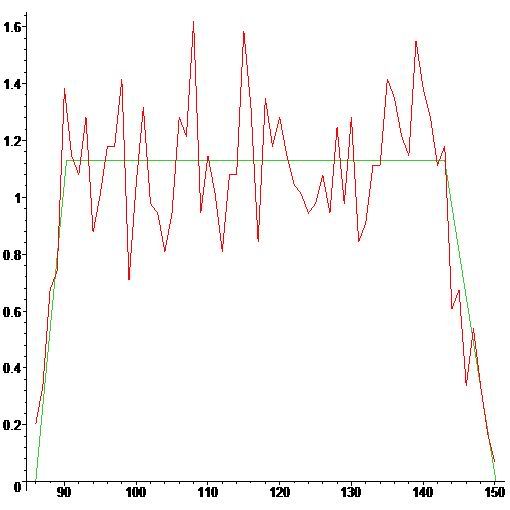
measured average value between a*1.05=90 and b=143 (upper floor) : 1.135
expected value : 20*ln(1.05)/(b/66-a/66) with a=86 and b=143 => 1.129
Not too bad : 0.4% variation <3.(0)Last edited by MarkovChain; 03-03-2012 at 08:43 AM.
Ultimate DPS simulator
https://docs.google.com/file/d/0B7wbcilaHsTecldhZm94a1gtZnM/edit
-
03-03-2012 04:05 PM #17
Knowing A and B are useful for figuring out cRatio, and thus figuring out things like mob attack, but you're right, it's insufficient to really tell how average damage is related to cRatio.
However I don't think your:
U=rand(0..1):V=rand(a..b):W=rand(0..1)
If U<0.30 then d=DMG*w
else d=V*w
sufficiently describes the process. When you're right on the edge of creating a spike (eg: cRatio at about 1.5), the average spike frequency is about 3x the average non-spike frequency. When you're near 1.0, with the spike right in the middle, the average spike frequency is about 5x the average non-spike frequency.
Just a rough review from Masa's data..
What I'm looking at:
Find the average frequency of all values aside from the 1.0 spike and any tail ends (artifacts of the 1.05 randomizer).
Subtract that average frequency from the frequency values of the spike values.
Sum up the remaining spike values.
Compare that sum with the grand total of all damage value frequencies to see what percentage of all generated damage values are encompassed in the artificial spike.
What I found:
Below 1.0 cRatio, down to ~0.8 (where max damage was still above 1.0), ~35% of all values came from the spike pool.
As cRatio dropped towards 0.75 (where max damage was capped at 1.0), the pool size dropped to about 25% of all values.
Not enough data (in this spreadsheet) below 0.75 to see how the trend continued.
Above 1.0 cRatio the pool size fluctuated from ~30% to ~37%. Either 33% or 35% would be believable.
As cRatio increases above 1.25, such that the min damage hits and sticks to 1.0, the percentage of the overall damage frequencies that are made up by the spike pool drop in a fairly linear fashion, reaching 12% at 1.4 cRatio.
As such you can't simply say that 30% (or whatever) of the time you generate a spike value, and the rest of the time you generate a value in the min::max range.
One might posit, then, that the chance of generating a frequency spike value is dependant on the total min:max range available.
Formulation:
(max - min)/baseDamage + fraction of total values in the spike
where max and min are corrected to generally exclude the 1.05 spread tails.
That formulation consistantly resulted in a final value of just about 0.9 (with rounding, between 0.89 and 0.91).
So, your threshhold for U would be: 1 - ((max - min)/baseDamage) - 10%
Not sure why there would be the extra -10% there, but could probably be explained based on expectations for the min::max range compared to base damage.
And this finally creates a formula that I'm comfortable with in terms of how the spike is generated. Still needs more work to calculate an average damage value based only on cRatio, though, and you can't completely ignore the min and max values (the a and b you mention in your post).(1)Last edited by Motenten; 03-03-2012 at 04:08 PM.
-
03-03-2012 04:29 PM #18
Note regarding Masa's data: the above work was from examining the behavior of 18 different cRatio tests that fell within the range of 0.75 to 1.5. The overall conclusion is still just a rough approximation, though.
(1)
03-03-2012 06:04 PM #19Player
- Join Date
- Aug 2011
- Posts
- 23
- Character
- Masamunai
- World
- Cerberus
- Main Class
- THF Lv 90
I "could" actually tell you the average dmg just from regressions from all my parses:
Avg DMG =~ BaseDMG x (0.8 x cRatio + 0.2), in the range 0.7 <~ cRatio <= 1.5
and =~ cRatio at 1.5 <= cRatio < 2
... But since it's comes from directly from data.... I would rather get this average from a global dmg formula. The problem is gotta define properly this formula with ALL its parameters exactly defined, so certainly not from approximate guesses and even worse, ignored min/max. That's why i don't use/post this average formula on wikis...
Also, you saying signatures means jackshit ? then don't ask for them with :
You can be thankful to Motenten who just provided it, and note it's still a ROUGH approximation, ie not as reliable as you sound just from 6 parses... Originally Posted by MarkovChain
(0)Majestic LS
03-03-2012 09:16 PM #20Player
- Join Date
- Mar 2011
- Location
- Windy
- Posts
- 1,429
- Character
- Pimpchan
- World
- Quetzalcoatl
- Main Class
- MNK Lv 99
I didn't use a dumb a approximation for the frequency dude, I've explained in the OP that you can calculate the frequency spike. It IS
q+(1-q)*ln(1.05)*DMG/(b-a)
The problem comes from reverseing the formula at certain values where you divide by small quantities aka r~1 for instance.(0)Last edited by MarkovChain; 03-03-2012 at 09:41 PM.
Ultimate DPS simulator
https://docs.google.com/file/d/0B7wbcilaHsTecldhZm94a1gtZnM/edit
 Reply With Quote


|
© SQUARE ENIX FINAL FANTASY, SQUARE ENIX, and the SQUARE ENIX logo are registered trademarks of Square Enix Holdings Co., Ltd. Vana'diel , Tetra Master, PLAYONLINE, the PLAYONLINE logo, Rise of the Zilart, Chains of Promathia, Treasures of Aht Urhgan, and Wings of the Goddess are registered trademarks of Square Enix Co., Ltd. The rating icon is a registered trademark of the Entertainment Software Association. All other trademarks are the property of their respective owners. Online play requires internet connection. |